Have you met our chatbot, Chip? Click the chat icon at the bottom right of your screen to ask him anything!
He can check stock for you and provide detailed information about our products.


SOSTENIBILIDAD
En Z Collection, estamos comprometidos a promover la responsabilidad ambiental y la sostenibilidad en todos los aspectos de nuestras operaciones comerciales. Como distribuidor de azulejos con sede en el noroeste del Pacífico, reconocemos la importancia de salvaguardar nuestro planeta para las generaciones futuras. Nuestra dedicación a la sostenibilidad abarca varias áreas clave.

CERAMIC TILE FOR A SAFE AND HEALTHY ENVIRONMENT
Creating a healthy environment is more important than ever before. Materials in areas where we spend significant time on a daily basis have the potential to affect our health both positively and negatively.
Ceramic-based materials are appreciated for their absence of harmful chemicals, easy maintenance, and the ability to promote cleanliness and hygiene. Every type of ceramic tile, including porcelain tile, quarry tile, wall tile, and pressed pavers, share all these benefits of ceramic tile:
Eco-friendly maintenance: No harsh chemicals are necessary for cleaning! Wiping with some soap and water is all that’s needed to clean up most messes.
Bacteria-resistant: Ceramic tile is inhospitable to the growth of bacteria and other microbes such as mold.
Antimicrobial: Ceramic tile options are available that can suppress and even destroy harmful microorganisms, such as mold, fungi, bacteria, and viruses.
Allergen-free: The high firing temperature of ceramic tile — generally more than 2000°F — burns off all organic compounds. Plus, ceramic’s nonporous surface doesn’t allow allergens in the environment such as dust, dirt, and pollen to penetrate.

Pixy 2x6 Jade

Akira 2.5x9 Blue
No volatile organic compounds (VOCs): VOCs are harmful gases that cause various health concerns and are emitted by virtually all nonceramic flooring types.
No formaldehyde: Certain levels of formaldehyde can irritate asthma and other respiratory disorders, but ceramic tile does not contain formaldehyde.
No polyvinyl chloride (PVC): PVC is a resin found in vinyl flooring that contains phthalates and organotin, both a concern among health experts.
No plastic: The health and environmental concerns associated with plastic aren’t an issue for ceramic tile.
Fire-resistant and nontoxic: Ceramic tile doesn’t melt, burn, or emit any toxic fumes when exposed to fire.
Naturally occurring materials: Ceramic tile is a healthy choice for both you and the environment. The natural clays and other materials used to make ceramic tile are plentiful and are often sourced within 500 miles of manufacturing.
Slip-resistant: Options are available that are classified for a wide range of appropriate uses in dry, wet, indoor, outdoor, and oil/grease conditions.
HEALTHY OUTDOOR LIVING SPACES
Ceramic tile is one of the most eco-friendly design choices for outdoor living spaces, allowing you to build alongside nature without causing nature any harm. This starts with the fact that ceramic tile introduces no harmful materials or toxins into the earth — no plastic-based materials, volatile organic compounds (VOCs), polyvinyl chloride (PVC), or formaldehyde.
EXTRA RESOURCES
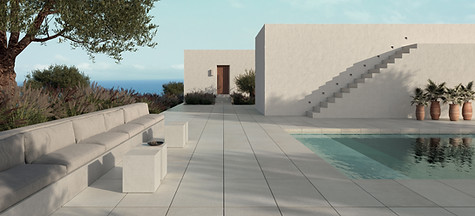
Crea 32x32 Calce (White)

ENERGY + LIFE CYCLE COST SAVINGS
EXCEPTIONAL LIFE-CYCLE COST = BEST VALUE
Ceramic tile has an exceptional life cycle. See the life-cycle cost study below for data on how ceramic tile outperforms other floor finishes in cost per square foot over time. Ceramic tile has been the preferred choice around the world for centuries for its timeless beauty and durability.
REGIONAL MANUFACTURING AND RAW MATERIALS
With tile manufacturers in many regions of North America, tile and installation products made with local raw materials are widely available, greatly reducing the energy consumption and emissions of long-distance shipping. In many cases, the raw materials are mined within 500 miles of both the manufacturing facility and the job site. Plus, the clays and other materials used to make tile are plentiful.
LOWER ENERGY NEEDS
Tile can reduce the amount of energy needed for heating and cooling because of its exceptional thermal mass. Additionally, ceramic tile is an ideal choice for ventilated façade projects. A ventilated tile façade can reduce a building’s energy consumption by 20% to 30% due to the natural chimney effect it creates between the structure and the cladding. Hot air is evacuated in summer, and insulation is more effective in winter.
REDUCED HEAT ISLAND EFFECT
Using light-colored tiles instead of traditional paving materials can lower an area’s heat absorption, or heat island effect. Green buildings in urban areas in particular are required to reduce the potential heat island effect.
RECYCLED CONTENT AND WASTE RECLAMATION
Many factories are effectively closed-loop facilities with zero waste, high levels of recycling, and efficient resource management. Also, ceramic tile finishes are among the few surfaces that can be salvaged in a major renovation and typically qualify for clean fill use.

ReVive 12x24 Greige

LIFE CYCLE COST ANALYSIS
Because a tile installation will last as long as the building it’s installed in, its environmental impacts are minimal when compared to other surface coverings that would have to be replaced numerous times over the life of the building. This also means that tile costs less per square foot over the long haul, whereas carpet, vinyl, and other floor coverings are significantly more expensive due to their replacement, maintenance, and refinishing requirements.
A study by Emily Lorenz, PE, F-ACI, an independent cost consultant, analyzed the life-cycle costs of various flooring options, including tile, hardwood, laminate, carpet, vinyl, and other popular choices. After appraising initial installation costs, replacement costs where relevant, and custodial maintenance expenses, for each option over its entire life cycle, the study found tile to be the most affordable flooring type. In fact, all types of tile cost less than $0.99 per square foot per year while poured epoxy, VCT, and sheet vinyl flooring were the most expensive over the life of a building. To see all the analyses, refer to the author’s full report.
Resources:
Life Cycle Cost Analysis — Flooring Coverings Comparison Report

CERAMIC TILE'S LOW ENVIRONMENTAL FOOTPRINT
Environmental Product Declarations (EPDs) illustrate how ceramic tile delivers both performance and transparency in terms of sustainability, whether your project is residential or commercial.
EPDs for North American-made ceramic tiles, mortars, and grouts all report very low 75-year environmental impacts per installed square meter. In fact, when the EPD for North American-made ceramic tile is compared to the generic EPDs for other types of flooring, developed under the same product category rules and using the same building service life, North American-made ceramic tile has the lowest overall environmental impact across all impact categories.
This includes the lowest (GWP) and the lowest Fossil Fuel Resource Depletion. GWP is the key factor used to determine a product’s embodied carbon. When compared to UL Certified EPDs for other types of flooring developed under the 2018 North American Flooring Product Category Rule, UL 10010-7, ceramic tile has the lowest 75-year GWP value, meaning it also has the lowest cradle to grave embodied carbon.
Over 85% of North American ceramic tiles are covered by the industry-wide ceramic tile EPD.
Simply stated, the industry-wide EPD is a report of the environmental footprint of the North American tile industry. The environmental impacts reported by the EPD are significantly lower than those reported by EPDs for flooring composed of plastic-based materials, such as luxury vinyl tiles and planks. In particular, a direct comparison to publicly available UL-Certified industry-wide EPDs for vinyl tile and rigid core board reveals the following:
-
Vinyl tile’s 75-year GWP and fossil fuel resource depletion are two and three times higher, respectively, than ceramic tile’s GWP.
-
Rigid core board’s 75-year GWP & fossil fuel resource depletion are 3 & 5 times higher, respectively, than tile’s fossil fuel resource depletion.
Regarding embodied carbon, it is important to consider a product’s cradle to grave GWP. A cradle-to-grave GWP assesses each stage of a product’s life cycle— production, construction, use, maintenance, refurbishment and replacement, and end of life.
Compared to other flooring products that need to be replaced more frequently, ceramic tile’s long life means it is both cost-effective and a smart choice for reducing embodied carbon, as well as other negative environmental impacts, including resource use, and demolition waste.

GLOBAL WARMING POTENTIAL

FOSSIL FUEL RESOURCE DEPLETION

MATERIAL INGREDIENT GUIDE
The Tile Council of North America (TCNA) and 17 North American tile manufacturers and TCNA members worked with WAP Sustainability, a leading consortium of sustainability experts with extensive familiarity with the ceramic tile industry, to produce GreenScreen Assessments® for the vast majority of material ingredients used by ceramic tile, mortar, and grout manufacturers. (GreenScreen® is a tool used worldwide to evaluate and benchmark chemicals and their associated hazards.)
This industry effort produced the largest crowdfunded accumulation of GreenScreen Assessments® ever created in a first-ever Material Ingredient Guide.
The Material Ingredient Guide provides the following:
-
Guidance for manufacturers when they are developing material ingredient reports
-
A list of the ingredients most commonly used by North American manufacturers and references to in-depth chemical assessments of these ingredients
-
Insights into satisfying green and healthy building criteria
The Material Ingredient Guide is representative of the ceramic tile industry’s commitment to consistency, thoroughness, and transparency in its product reporting, and comes on the back of many similar initiatives, such as environmental product declarations (EPDs) and Green Squared® product certifications.


Silva 2x12 Walnut
Following the steps outlined in the Material Ingredient Guide will make it easier to reference benchmarks when creating manufacturer inventories (MIs) and health product declarations (HPDs) to assist in obtaining green building optimization credits and comply with green building certification programs such as LEED, WELL, and the Living Building Challenge.
TCNA’s Material Ingredient Guide provides in-depth instructions and templates for manufacturers to follow when developing an HPD or MI. For both, a manufacturer must first have a product content inventory and screening/assessment results for each material ingredient included in the inventory. The Material Ingredient Guide’s GreenScreen Assessment BM scores for the ingredients common to ceramic tile, mortar, and/or grout can be helpful when developing and disclosing a product content inventory. Also, an HPD or MI developed using this information by a manufacturer who collaborated in the development of TCNA’s Material Ingredient Guide is offered third-party verification, based on an arrangement between TCNA and WAP Sustainability. A third-party verified HPD or MI with full GreenScreen Assessment BM scores is highly credible and facilitates green and healthy building “optimization” by providing a high level of material ingredient transparency.
For More Information


GREEN SQUARED CERTIFIED
Green Squared® is the world’s first multi-attribute sustainability standard and certification program for tile and the associated products needed to install tile, which includes ceramic and glass tiles, mortars, grouts, backer-boards, membranes, and other installation materials. Green Squared® is a cradle-to-grave performance standard that eliminates the need to cross-evaluate single-attribute sustainability claims.
For a product to be Green Squared Certified® means it meets the American National Standard Specifications for Sustainable Ceramic Tiles, Glass Tiles, and Tile Installation Materials (ANSI A138.1). To be in conformance, products must meet a broad array of rigorous sustainability requirements and electives, as set forth in the standard. The Green Squared® framework for product evaluation and certification is in accordance with ISO Type 1 environmental labeling and declaration requirements (ISO 14024). Products independently verified as conforming to the Green Squared® standard may bear the Green Squared Certified® mark.
Developed by an ANSI-accredited committee of green building professionals, manufacturers, distributors, installers, and other stakeholders, the Green Squared standard, ANSI A138.1, contains a spectrum of multi-attribute environmental and social criteria:

ENVIRONMENTAL PRODUCT CHARACTERISTICS
The first section of ANSI A138.1 standardizes product attributes such as the amount of recycled content, level of volatile organic emissions, amount of indigenous raw materials, etc.
Three levels of recycled content and reclaimed waste are defined in the standard. Level one is mandatory for conformance, and levels two and three are elective. Thresholds vary depending on product type.
There are also three standardized levels of indigenous raw material content. Recognizing the environmental burden from transportation, indigenous raw materials are those extracted within 500 miles of the manufacturing site. If transported by rail or sea, the limit is 2000 miles. All three levels are elective.
There are five standard attributes for sustainable packaging. All five are elective, but it is mandatory that at least one be achieved:
-
Minimal packaging (packaging cannot exceed a specified percentage of the product weight)
-
Recyclable packaging (a specified percentage of the packaging is recyclable)
-
On-site reusable packaging (100% reusable on site)
-
Biodegradable or compostable packaging (meets specific ASTM biodegradability criteria)
-
Recycled content packaging (contains a specified percentage of recycled content)
Mandatory for conformance to ANSI A138.1, a product must meet industry standards for durability and performance. For example, tile must comply with ANSI A137.1. Also mandatory for conformance, a product shall have low (for installation products) or no (for tile) volatile organic compound (VOC) emissions. Environmentally friendly maintenance instructions must also be available.
Elective options for conformance to A138.1 include criteria for solar reflectance index (SRI), light reflectance value (LRV), and sound abatement. Also, electives for life cycle assessment (LCA) and/or environmental product declaration (EPD) are available.

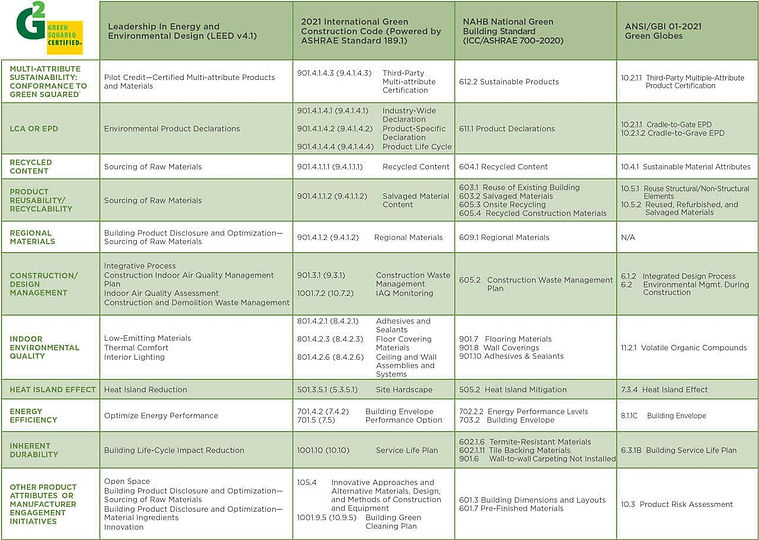
SPECIFYING GREEN SQUARED
LEED V4.1
Under the LEED pilot credit, Certified Multi-Attribute Products and Materials, a point toward LEED certification can be earned by using products from manufacturers who have confirmed multiple environmental attributes through an independent, third-party certification, such as Green Squared®.
In order to achieve this point, at least 25%, by cost, of the total value of permanently installed products in a project must have earned certification under any of the following programs:
-
Level® certification for furniture
-
NSF 140 certification for carpet
-
NSF 332 certification for resilient flooring
-
Green Squared certification for tiles and tile installation materials
-
UL 100 certification for wall board
-
NSC 373 certification for natural stone
-
NSF 343 for wallcoverings
-
NSF 347 for roofing membranes
Additionally, the product literature must disclose which sections of the relevant multi-attribute sustainability standard were met. An LCA (life-cycle assessment) conforming to ISO 14044 must be available as well, either as a component of or in addition to the product’s multi-attribute certification.


SIX STEPS OF CERTIFICATION
The ANSI A138.1 standard and certification of conformance to that standard (Green Squared® certification) were developed specifically to be relevant to products no matter where in the world they are produced. Developed to meet the sustainability needs of the North American marketplace, the Green Squared standard and certification program provide all producers, foreign and domestic, with a clear benchmark for designing sustainable products that can be accepted by North American green building programs.
Here’s what to expect when pursuing Green Squared® certification:
1. APPLICATION PROCESS
Manufacturers seeking to have their product(s) certified apply to one of three internationally recognized Green Squared certification agencies:


2. EVALUATION
The certification process involves the following in determination of ANSI A138.1 conformance:
- General evaluation of the applicant organization
- Product evaluation
- On-site facility evaluation
3. CONFIDENTIALITY
All proprietary information remains confidential between the certification agency and the manufacturer.
4. CERTIFICATION
-
Green Squared Certified® mark awarded by certification agency
-
Scope of certified products determined by certification agency
-
Certifications valid for a five-year period
-
Surveillance audits each year
-
Recertification after five years
5. PRODUCT LISTING
-
Agency lists all certified products
-
Certified products also listed on GreenSquaredCertified.com
-
Certified product data syndicated by Ecomedes to Fulcrum, as well as to many public and private A&D purchasing libraries
6. USING THE MARK
Once a product is third-party certified as meeting the ANSI A138.1 standard, the certification body awards use of the Green Squared Certified® logo:
-
Directly on certified products
-
Packaging of certified products
-
Promotional literature published about certified products
The easily-recognizable Green Squared Certified® mark helps architects, designers, and end users choose products that meet a broad range of sustainability criteria.
With so many different brands of green today, Green Squared® certification provides authenticity and conveys that the product certified is the real deal. The Green Squared framework for product evaluation and certification is in accordance with ISO Type 1 environmental labeling and declaration requirements (ISO 14024) in a marketplace.
Information on this page is sourced from WhyTile.com. Read more below.


